
Escalating tensions involving Iran are once again putting global markets on edge. Oil prices are climbing, stock market volatility is creeping higher, and inflation risks are quietly returning to the conversation. But the real pressure point isn’t just missiles or military escalation—it’s shipping. Tankers are increasingly avoiding the Strait of Hormuz not because the route is physically closed, but because insurance markets are tightening and war-risk premiums are skyrocketing. When ships can’t get insured, they often don’t sail. And when they don’t sail, global energy markets feel it fast.
If you’ve followed markets long enough, you know how this movie usually starts.
A geopolitical flare-up hits the Middle East, oil jumps, equities wobble, and every portfolio manager on the planet suddenly becomes an amateur energy strategist.
The latest escalation involving Iran has dropped markets right back into that familiar script. Oil prices are rising again, volatility is creeping back into equities, and investors are being reminded—perhaps reluctantly—that geopolitics still matters to markets.
But the most interesting story right now isn’t just about missiles or troop movements.
It’s about ships.
More specifically, it’s about the ships that aren’t moving.
Oil Is Back Driving the Macro Narrative
The first reaction across markets has been exactly what you’d expect: crude oil moving higher.
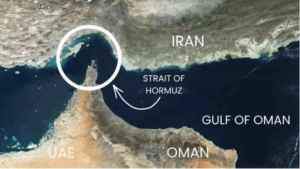
Whenever tensions escalate around Iran, traders immediately focus on the Strait of Hormuz, the narrow shipping corridor connecting the Persian Gulf to the open ocean. It’s one of the most important choke points in global energy infrastructure.
Roughly 20% of the world’s oil supply flows through that passage every day.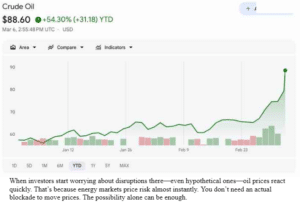
When investors start worrying about disruptions there—even hypothetical ones—oil prices react quickly. That’s because energy markets price risk almost instantly. You don’t need an actual blockade to move prices. The possibility alone can be enough.
And that’s exactly what we’re seeing.
Oil has jumped as traders try to assess whether shipping routes, infrastructure, or production could be affected if the conflict escalates further.
Energy markets are essentially doing what they always do during geopolitical shocks: pricing the worst-case scenario first and asking questions later.
Stocks Don’t Love Expensive Energy
When oil spikes, equity markets usually take a step back.
The reason is simple: higher energy prices ripple through the entire economy. Think of it as a global tax that nobody voted for.
Consumers spend more on gasoline. Airlines face higher jet fuel costs. Manufacturers see shipping and logistics expenses rise. Businesses across the economy feel margin pressure.
That’s why economically sensitive sectors—airlines, transportation companies, consumer discretionary businesses—often struggle when oil moves sharply higher.
Investors know that sustained energy spikes can slow economic growth, so markets typically shift into a more cautious posture when crude prices start running.
That doesn’t mean markets collapse. But it does mean volatility tends to rise and leadership inside the market can change quickly.
The Shipping Problem No One Is Talking About
Here’s where the situation gets more complicated.
It’s not just the physical risk of the Strait of Hormuz that matters.
It’s the insurance market.
Commercial shipping relies heavily on specialized insurance policies known as war-risk insurance. These policies protect shipowners and cargo companies from losses if vessels are damaged, seized, or attacked in conflict zones.
When geopolitical tensions spike, insurers reassess the risk—and premiums can skyrocket overnight.
In some cases, coverage becomes extremely expensive. In other cases, insurers may temporarily refuse to cover voyages through specific regions altogether.
That’s what happens with ships traveling through the Strait of Hormuz.
Without insurance, most shipping companies simply won’t send their vessels through a high-risk area. The financial exposure is just too large. A single oil tanker can carry cargo worth well over $100 million, and the vessel itself may be worth just as much.
No insurance means no sailing.
So even if the strait remains technically open, traffic can still slow dramatically because shipowners and cargo companies can’t obtain affordable coverage.
That’s how geopolitical risk turns into a financial bottleneck for global trade.
When Insurance Becomes the Supply Shock
Markets often assume supply disruptions only occur when infrastructure is damaged or shipping lanes are physically blocked.
But financial constraints—like insurance—can create a similar effect.
If fewer tankers are willing or able to pass through the Strait of Hormuz, the flow of oil to global markets slows. Even modest reductions in shipping can tighten supply and push prices higher.
Energy markets are extremely sensitive to these bottlenecks because global oil supply chains operate with relatively little slack.
So the real issue isn’t just military escalation.
It’s the possibility that risk management decisions by insurers and shipping companies could effectively throttle the movement of energy exports out of the Persian Gulf.
Inflation Risks Are Creeping Back
Just as markets were getting comfortable with the idea that inflation might finally be cooling, energy prices are back in the spotlight.
Oil has a way of sneaking back into the inflation conversation whenever geopolitics get messy.
Higher crude prices feed into transportation costs, logistics expenses, and eventually consumer prices. Gasoline alone has an outsized psychological and economic impact on inflation expectations.
If energy prices remain elevated long enough, central banks—including the Federal Reserve—may find themselves navigating a more complicated policy environment.
Rate cuts that once seemed inevitable can quickly become uncertain when energy-driven inflation starts pushing the wrong direction.
It’s a reminder that inflation doesn’t always follow a straight line down.
Sometimes geopolitics gives it a nudge higher.
Volatility Is Making a Comeback
Markets had grown used to a relatively smooth ride.
The past year saw volatility gradually compress as investors became more confident about economic resilience and the trajectory of inflation.
But geopolitical shocks have a way of breaking that calm.
The Iran conflict has pushed volatility higher across commodities, currencies, and equities as investors try to price in a wide range of possible outcomes.
No one knows exactly how this situation evolves. Markets are essentially reacting to probabilities rather than certainties.
And when probabilities shift quickly, markets tend to move quickly as well.
The Bottom Line
The current conflict involving Iran is reminding markets of something they occasionally forget: geopolitics still matters.
Oil prices are climbing. Volatility is picking up. Inflation risks are creeping back into the conversation.
But perhaps the most fascinating development isn’t happening in financial markets at all.
It’s happening in the shipping lanes of the Persian Gulf—where tankers are hesitating not because they can’t sail through the Strait of Hormuz, but because they might not be able to insure the trip.
And in global energy markets, sometimes the biggest supply shock isn’t a missile.
It’s a contract that nobody wants to sign.